
octemu
Octatrack emulator and development environment for firmware customizations
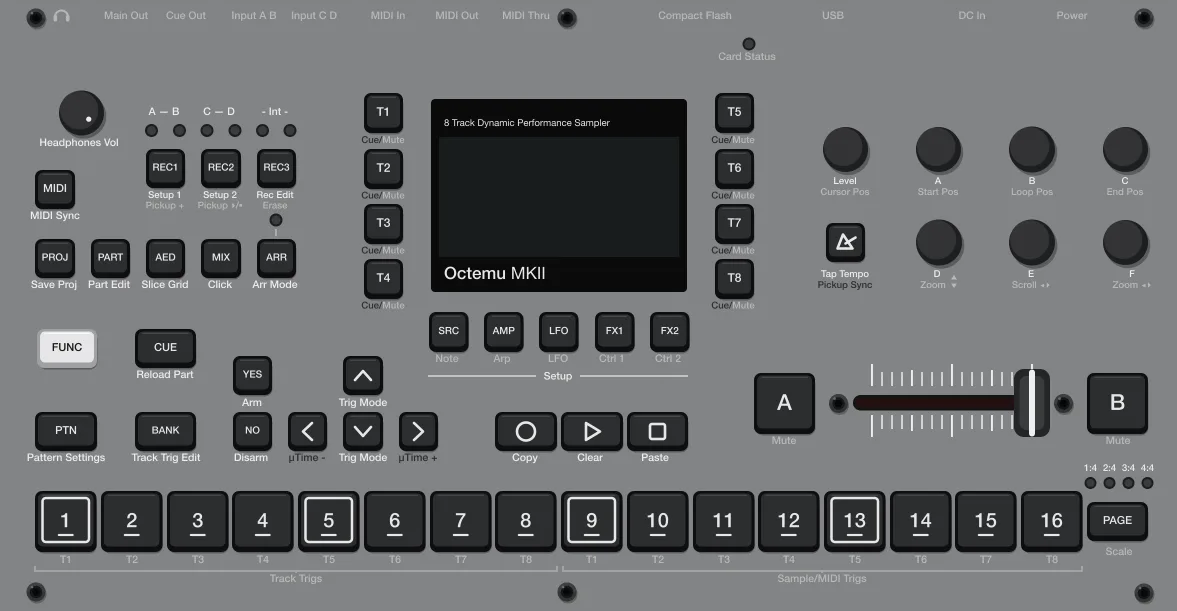
About
Highlights
- A windowed Octatrack with front panel that boots from a CF card image
- octdsp: runs the Octatrack's DSP cores alone, without QEMU
- Firmware experiments: the RECEIVE machine (a NEIGHBOR machine that mixes up to six tracks), USB MIDI and 16-channel USB audio
- Fixtures and USB test harnesses
What you need
macOS, the build dependencies reported by make doctor, your own official OS and about 1.2 GB of space for the vendored tools.
Good to know
Playback still warbles and USB audio has limits. Locally built combined binaries must not be redistributed. The USB audio experiment also needs a payload file on the CF card root.
README
octemu
octemu is an Octatrack emulator for macOS, built around QEMU (ColdFire MCF54455), dsp56300, and SDL2 with the goal of providing a development environment for firmware customizations, including MIDI and audio over USB.

octemu & octdsp
Build
make doctor   # what your computer is missing, with the formula for each
make setup    # vendor toolchain: dsp56300, elektron-firmware-tool
make os       # fetch + unpack YOUR copy of the OS -> out/os/main.bin
make qemu     # the patched QEMU (~10-15 min)
make          # both programs, the panel raster, a blank CF card
make setup and make qemu clone their dependencies into vendor/, which
ends up around 1.2 GB.
Run
./octemu                                                  # the Octatrack, windowed
./octdsp --in-a sin:440 --out-main out/x.wav --timeout 2  # its DSP cores, no QEMU
octemu boots from the CF card image make leaves in out/state/, and writes
its battery file alongside on the first run.
Known issues
The playback warbles. I think this can be fixed by buffering.
Demo
This will create a CF card with a simple set and project, where track 1 is configured with a STATIC machine and a sine wave assigned to its first slot:
make fixtures
cp -R out/fx2 out/play
./octemu --cf-card out/play/card.img --nvram out/play/nvram.bin
Work on the copy: out/fx2 is a cached fixture tests start from, and anything
you save in the emulator writes straight back into it. Delete out/fx2 to
rebuild it.
Firmware customizations
Customizations are applied to a stock Elektron-supplied firmware image you provide, using elektron-firmware-tool.
Caution
I take no responsibility for any damage to your Octatrack, data loss to your CF card, etc., from attempting to use these firmware customizations. Be careful.
RECEIVE machine
This is a generalization of the NEIGHBOR machine. Instead of only receiving the preceding track as input, you can choose up to 6 tracks to receive as input, p-lock how much each track contributes to the mix, and place trigs.
You can create feedback loops this way. Be careful.
The RECEIVE machine, like the NEIGHBOR machine it replaces, introduces a 16-sample delay.
make fw-receive
./octemu --os out/OCTATRACK_OS1.40C_receive_<build>.os

USB-MIDI
Reverse-engineering revealed partial support for USB-MIDI already implemented in the Octatrack firmware. This customization completes it. I've done some basic validation, and it seems to work. It is a mirror of the DIN ports.
make fw-usb-midi
./octemu --os out/OCTATRACK_OS1.40C_usb-midi_<build>.os --midi
USB-Audio
Adds a UAC2 interface: at high speed the Octatrack appears as a 16-channel 44.1 kHz 16-bit USB audio input — the eight tracks, each as a stereo pair (track 1 on channels 1/2 … track 8 on 15/16), tapped post-FX and pre-fader. At full speed it falls back to the stereo sum of the tracks. The source is the per-track post-FX buffers the DSP returns to the CPU.
make fw-usb-audio
This one does not fit in the firmware image, so a unit needs both halves: the flashed image, and a payload on the CF card root under that exact name.
cp out/USBAUDIO.BIN /Volumes/OCTATRACK/
If you have problems, you can recover by
- holding "NO" at boot (skips loading
USBAUDIO.BIN). - deleting
USBAUDIO.BINfrom the CF card.
Test fixture
out/sig8 is a test set where each of the eight tracks plays a distinct
stereo tone on a one-shot trig — track 1 at 250/300 Hz through track 8 at
950/1000 Hz — so every one of the sixteen USB channels carries a unique
frequency and both the track-to-channel mapping and left/right can be checked
by ear or by measurement.
tests/build-sig-fixture.sh # generates the samples and the set (~12 min)make test-emu-usb-audio-stream16 builds it if needed and runs the 16-channel
gate on it: every USB channel must carry its own frequency, and every channel
pair must equal its track's post-FX readback sample-exact.
Boot it and press PLAY to hear the eight tones:
./octemu --cf-card out/sig8/card.img --nvram out/sig8/nvram.bin
tests/usb-audio-sigcheck.py --pcm capture.pcm confirms each channel carries
its expected frequency from a 16-channel capture.
Known issues
- You may have to re-plug the USB cable.
- Only tested on macOS with
sox, not in a DAW. - Some crackles may be audible.
Licensing & legal
Elektron, Octatrack and Octatrack MKII are trademarks of Elektron Music Machines MAV AB. This project is unaffiliated with and unendorsed by them. Nothing Elektron-owned is in this repository.
The octemu and octdsp binaries combine sources under incompatible licenses.
You can build them on your own computer and use them, but you may not
distribute them. This project's own sources are MIT-licensed.
See LICENSE.md for more details.
Acknowledgements
Shoutout to the following projects:
- mxldyn/octamax and sambanks/octabam: the projects that inspired this one and did the first reverse-engineering passes (that I am aware of) on the Octatrack.
- mischa85/elektron-firmware-tool: used for modifying Octatrack firmware images.
- The Usual Suspects: creators of the dsp56300 library used for emulating the Octatrack's DSP cores.
This project was built essentially entirely with Claude Code. I have de-slopped it where I could.
Pictures in the README load from GitHub.
- Language
- C
- License
- Other
- Stars
- 25
- Forks
- 3
- Created
- 09-19-2026
- Last commit
- 1 week ago
- Topics