
About
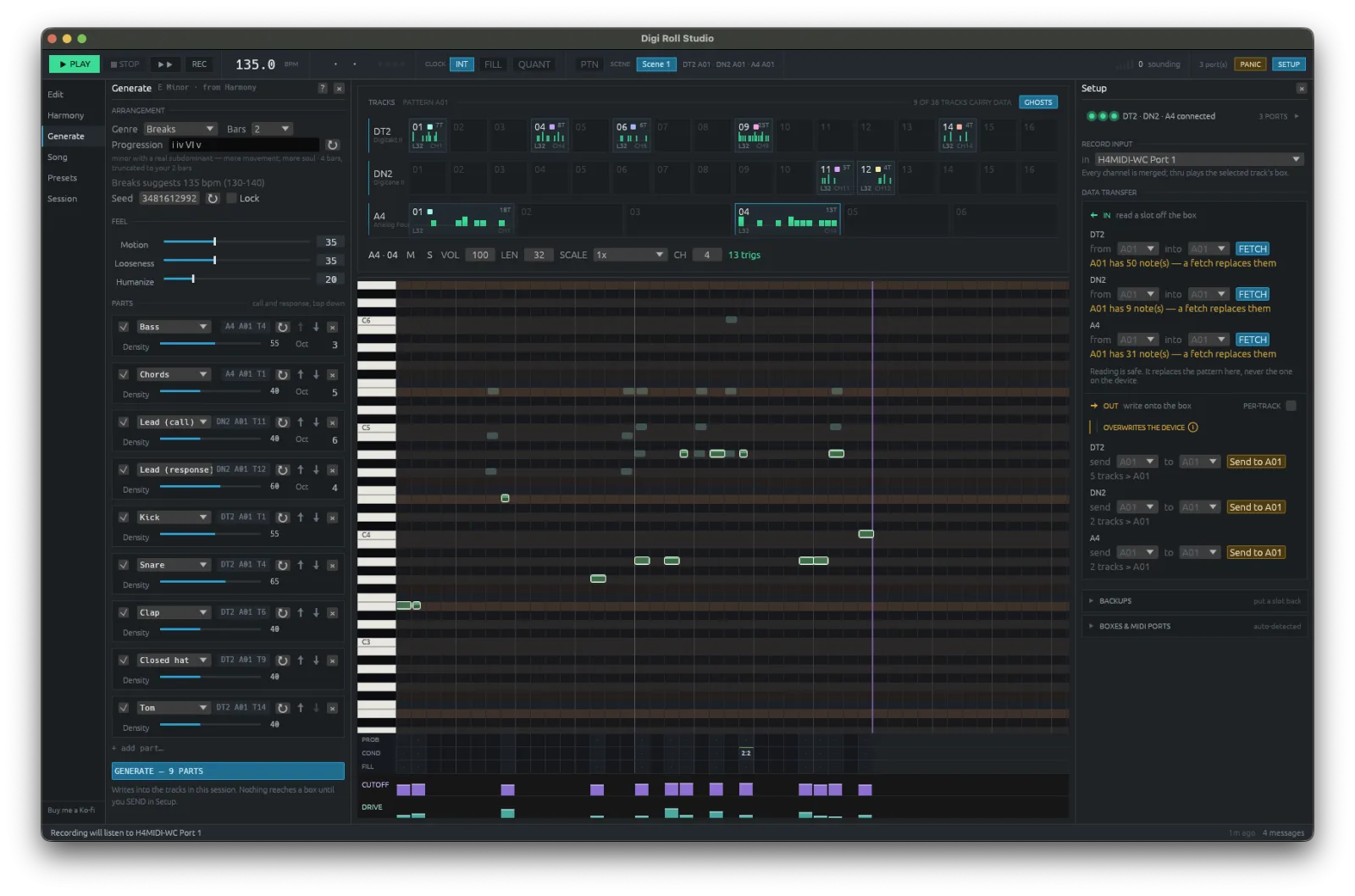
Basically it's a piano roll for your boxes... it can read the patterns from your device, into a piano roll you can edit them, and then sync the data right back to your device.
Features include:
- a Piano Roll
- Import/export of patterns
- audition presets
- harmonize a pattern
- generate midi patterns on the fly
- loads more
there's easy installers for mac/pc/linux here https://zooloo303.github.io/digi-roll/studio/
README
digi-roll-studio
Native Rust desktop sequencer for Elektron Digitakt II, Digitone II and Analog Four, built from digi-roll — a browser piano roll for the two digis.
Where digi-roll edits one track at a time in a browser, this sequences a whole studio: several boxes in one session, each with its own pattern, all playing to a shared clock. A DT2 and a DN2 together is the target case — 32 tracks — and an A4 adds six more.
All three boxes fetch, edit and write, through the same panels and the same write ceremony. The two digis speak Elektron's gen-2 dump protocol; the Analog Four speaks gen-1, which is a different pattern format and a slower wire, and the app hides both facts behind one button.
The protocol work this stands on is ported from
elk-herd by mzero (BSD-2-Clause), which
is the de-facto public documentation of Elektron's SysEx protocol. Without it
there is nothing here. See CREDITS.md for what came from where.
Hardware-verified OS support includes Digitakt II 1.16 (0079), Digitone II 1.11 (0059), and Analog Four 1.55D (0201). Pattern writes and restores passed full readback comparison on all three on 2026-09-09. Previously supported builds remain supported.
⚠ This app writes to your boxes
From the moment a box has an out port and Play is pressed it sends clock and notes. Three things overwrite what a box has stored: SEND TO BOX overwrites one track of one pattern slot, SYNC EVERY TRACK does that to every track of every box in one press, and BACKUPS replaces a whole slot — all sixteen tracks, the kit and its sounds. All three work on an Analog Four as well as a digi.
Every write goes through five rules that cannot be skipped:
- the whole destination pattern is re-read and backed up first — a backup that cannot be stored is a write that does not happen,
- the target's OS build is checked against an allowlist,
- you agree to a dialog naming exactly what changes,
- only the bytes that must change are changed, and
- the result is read back and byte-compared.
Use throwaway projects on your boxes anyway. This is beta software that writes to hardware you cannot easily undo.
Auto-connect is on by default and opens ports by itself every three seconds to ask an unclaimed Elektron-looking port who it is. That is read-only — two API requests — but it is worth knowing about before wondering what is holding a socket. The checkbox is at the bottom of BOXES.
A RECORD INPUT picked in Setup is the other port the app opens by itself. Whatever you play on it is echoed to the selected track's box, armed or not, so a keyboard on the desk sounds a box the moment a track is selected. That is notes, never SysEx, and recording a take changes only the session.
Status
MVP1 — reached 2026-09-04, and v0.5.4 as of 2026-09-09, which adds support for Digitakt II OS 1.16, Digitone II OS 1.11, and Analog Four OS 1.55D. Pattern imports, writes, and preset sends were tested on the updated devices. Still beta software that writes to hardware; the five write rules above are the reason that is a sentence and not a warning label.
| SysEx seven-bit, framing, pattern decode/encode | ported and verified against real DT2/DN2 captures |
| Trig conditions, p-lock lanes, pattern settings | ported both directions, against the committed captures |
| Core model | several boxes, track count and pattern length per model (16/128 on the digis, 6/64 on the A4), scenes, and a song of scenes — PLAN.md §2 |
| Safe write | all five rules as one function, and run on hardware — one track of one slot, from the app's own button, verified byte-identical on a DT2 and a DN2 |
| Backups and restore | a local store of the last 50 patterns overwritten, plus 10 pre-restore snapshots; a store failure aborts the write. A restore has been run on both boxes, byte-identical |
| MIDI I/O | on midir; enumeration, identity handshake, dump reads and writes, all run against all three boxes — including the A4's DIN pacing, which is part of the contract rather than a tuning knob |
| Engine, transport, clock | verified on hardware — a DT2, a DN2 and an A4 playing one clock in sync |
| Analog Four | a full transfer peer of the digis since 2026-08-31, and every claim here was made by the box. Plays: clock and transport receive, notes on channels 1-6 (four synth voices, FX, CV), 64-step patterns, all fourteen published CC/NRPN parameters swept. Transfers: 0x64 fetches any of 128 slots, the write goes back DIN-paced through the same safe-write ceremony, and a round trip — off the box, edited in the roll, back on — ran first time. Carries: velocity, note length, micro-timing and trig condition as named lanes, thirteen p-lock parameters that read, draw and edit, and — since 2026-09-02 — chords, as the trig's note plus the ARP menu's NO2–NO4 offsets, which is how the factory A01 plays them; they sound on a polyphonic kit with the arp off. Names its tracks' sounds off the box's edit buffer, which no digi can answer. The FX and CV tracks are read-only and byte-exact by decision — their p-lock id space has never been swept |
| Session file | a whole session round-trips through JSON, wired to Save/Open with a close guard, hardware-confirmed through a save/quit/reopen cycle. Saving is manual, but a crash is not the end of the work: unsaved edits are copied aside to the per-user data directory two seconds after the last edit (every twenty seconds if the edits never stop), and the next launch offers the copy back. The chosen file itself is still only written by a deliberate Save, so "quit without saving" still means what it says — see crates/app/src/ui/recovery.rs for why |
| Velocity, micro-timing | in the model, written to hardware, settable in the Edit panel and the roll |
| Ghost tracks | the pattern's other tracks drawn translucent behind the one you are editing, each in its own colour — GHOSTS in the TRACKS header, right-click a cell to leave a track out. A ghost of another length is drawn once, to its own loop point, rather than tiled or drifted |
| Harmony | key, scales, chord draw with a ghost, harmonise. A four-note chord written to a box and fetched back intact |
| Generator | seeded, nine modules, per-genre; a six-row arrangement has played and been synced to both boxes byte-identical. A Chord lead role (2026-09-02) transcribes the Analog Four's factory A01 — pedal tones held over a root that leaps octaves — and has played from an A4, as chords, through its ARP offsets |
| Preset browser | the selected box's whole +Drive soundbank library, searched and filtered by tag across every bank at once. Tags live inside each preset file, so the panel scans — cancellable, resumable, and cached per bank so a second open is instant and works with the box switched off. Three libraries indexed whole on hardware: a DN2's 1,189 presets (of which 388 are Digitone mk1 files, a second container format), an A4's 869, a DT2's 148. All three tag tables are calibrated exactly — 24 of 24 captures, checked against Overbridge's filter grid rather than the boxes' own screens, because an A4 truncates its tag row at four and shows only some of what a preset carries. The digis share one 32-cell table; the A4's overlaps it in two positions |
| Preset load | double-click puts a preset on a track, run on all three boxes. Two routes, one gesture: a digi addresses one kit track's sound, and the A4 — which looked for three days like a box that could not do this at all — has its whole working kit fetched, one 350-byte sound spliced in, and the kit sent back. That box replaces a track with an init sound rather than refusing a preset saved by an older OS, so the load converts the struct version first; the conversion is two bytes and was measured off the box's own sound pool, not derived. Foreign container formats are refused by magic and say so by name, per destination. What has not been run is REVERT, the mk1 refusal message, and the OS-build gate through this path |
| +Drive writes | the file-write trio (0x57/0x58/0x59) is implemented in digi_midi and hardware-verified for a single chunk, behind a second allowlist disjoint from the read one. The app itself never calls it — the only caller is one example, so nothing you can press writes a file to a +Drive. Above 16 KiB is refused rather than guessed, so no whole project has been written back. 0x5A Move, 0x5B Copy and 0x5C Delete are implemented nowhere in this workspace and nothing can reach them |
| Copy-track | the in-app whole-track copy works — Shift+C/Shift+V in the TRACKS grid, re-reading the source at paste time so it survives a scene change. Clicking a cell and pressing Delete clears that track — trigs and p-lock lanes, undoable, with the track's own name, channel, port, length and scale left alone. Shift+Up/Shift+Down transposes the selected track an octave and Alt+Up/Alt+Down a semitone — the whole track, moved whole or refused, never clamped or dropped — with the same four moves on buttons in the Edit panel. The box-to-box copy, which translates p-lock lanes between two boxes' payloads by parameter name, is ported and still has no caller |
| Song mode | rows of scenes with play count, length, mute and an END row, plus the LST trig condition it makes answerable. Run on hardware 2026-09-04, no issues — the §9 ledger entry is closed. Per-row tempo is deliberately not built: the session has one clock |
| Live recording | a keyboard on the RECORD INPUT plays through to the selected track's box; REC arms, PLAY runs the take, STOP ends it as one undo step. Notes land on the armed track's own grid under polymeter and SCALE, overdubbing every pass like the box's LIVE REC, with QUANT to snap and a four-note cap per step. Played on a DT2 and an A4 the day it was built, 2026-09-05. Not yet done: a recorded pattern written back and fetched byte-exact, a recorded triad read off the A4's screen, and a measured thru latency — PLAN.md §12 |
| MIDI file import | two gestures over one engine. Into this track: a single-part file that fits imports in one click, anything else asks which part, from which bar, for how many bars. As a song: from the SONG and SCENES panels, a Standard MIDI File is scored into parts, fitted onto bar-aligned pattern segments with identical segments deduplicated into repeats, auto-mapped onto the desk's tracks (drums fanned out one pitch per DT2 track), and applied as fresh patterns, scenes and rows in one step. Nothing about an import touches a box. Built and tested headless 2026-09-05; the song import has not been played on a desk and no DAW export is committed as a fixture — PLAN.md §11 |
| Platforms | macOS, Windows and Linux all build, test and package on CI, and all three have been installed and launched from their own artefact. On Windows a DN2 was auto-connected and written to; a DT2 has not met a Windows build. On Linux (Arch/Omarchy, from the .pkg.tar.zst) a DN2 was auto-connected over ALSA and named its OS build — no write has been run from a Linux build, and the portable tarball has been installed but not yet run against a box |
What is open is in PLAN.md §1 under "Still open", and the shape of it is
the same throughout: the happy paths have met a box and the refusals mostly have
not. The box-to-box copy has no caller, paste waits on a movable playhead, a
song cannot yet be synced to a box's own song slots, and the two 2026-09-05
features each owe a hardware pass (PLAN.md §11.8 and §12.7).
Build
Requires Rust 1.95+ (the MSRV egui/eframe 0.36 set, and enforced by rust-version). Linux additionally wants libasound2-dev for ALSA; macOS
and Windows need nothing beyond the toolchain, which is the whole reason this
uses midir rather than rtmidi.
cargo build --release
cargo test --workspace          # 2,127 tests, no system dependencies
cargo run -p digi_roll_studio   # the app
Packaging
packaging/macos/build-dmg.sh          # Digi-Roll-Studio-<ver>-macOS-AppleSilicon.dmg
packaging/linux/build-tarball.sh      # Digi-Roll-Studio-<ver>-Linux-x86_64.tar.gz
packaging/linux/build-pkg.sh          # digi-roll-studio-<ver>-1-x86_64.pkg.tar.zst
The Windows installer is built on Windows, by
packaging\windows\build-installer.ps1. Each artefact is built on the platform
it runs on: pushing a v* tag runs all four on CI and drafts a release with the
four assets attached — see packaging/README.md, which
also explains why the macOS bundle has to be ad-hoc re-signed after it is
assembled and not before, and why Linux ships two downloads rather than one.
On Linux the tarball installs per-user into ~/.local with the install.sh
inside it and needs no root; on Arch and derivatives prefer the package, which
is the only one of the four that can declare the libraries eframe and wgpu
dlopen at runtime and so refuse to install where the app would not start.
Hardware is never part of the dev loop. The protocol suites read .syx
captures from crates/protocol/tests/fixtures/ — 34 real dumps, 1.8 MB,
committed so the tests run anywhere. Thirteen are DT2/DN2 and twenty-one are the
Analog Four's, one per question its lanes and p-lock pool were mapped one at a
time by; 32 .bin preset files sit under fixtures/drive/. The examples that
do talk to a box are listed in DEVELOPMENT.md by safety
class, most of them read-only — and that list is checked against the examples
directory by a command in the same section, because it has been incomplete
twice.
Workspace
crates/core— session/device/pattern/track model, edit ops, import/export, project file; the MIDI-file scorer and the import fitter, and the rules of a recorded takecrates/protocol— SysEx seven-bit, Elektron protocol, pattern structs, byte lanes (trig conditions, p-locks, swing), safe-write, copy-track and the backup stash; the gen-1 Analog Four format in its owna4_*modules rather than behind a generation flag; the +Drive file API and preset/sound decodingcrates/generator— seeded pattern generatorcrates/midi— port enumeration and I/O, onmidir; the live input a keyboard is recorded fromcrates/engine— transport, clock, scheduling; thru and note placement for recordingcrates/app— egui UI
Documents
PLAN.md— the architecture, the model, and the rules that are not up for renegotiation. Source comments cite it by section (PLAN.md §7 rule 3); those numbers are stable. Its §9 and §10 are four fifths of it and are a hardware ledger rather than a plan — what has touched a box, and every Analog Four offset with the screen reading that graded it. §11 and §12 are the MIDI-import and live-recording designs, folded in with what was built and what each still owes.DEVELOPMENT.md— how it was built, the hardware examples by safety class, your boxes' own MIDI settings that this app cannot reach, and twenty-one lessons that each escaped a green test suite at least once.packaging/README.md— how the four downloads are built, why the asset filenames are load-bearing, and the three Windows-only things that never show up in acargo run.CREDITS.md— elk-herd, digi-roll, and the third-party notices.
License
GPL-3.0-or-later — see LICENSE.
The elk-herd-derived parts of crates/protocol and crates/midi are
BSD-2-Clause, © mzero. BSD-2 is GPL-compatible, so the combined work ships under
the GPL while those files keep their original notices; CREDITS.md
reproduces the BSD-2 terms in full, as it must. Keeping that attribution intact is
PLAN.md §7 rule 6 and is not optional.
Not affiliated with, endorsed by, or supported by Elektron. "Digitakt" and "Digitone" are their trademarks. The protocol knowledge here is reverse-engineered and public.
Pictures in the README load from GitHub.
What's New
What's Changed
- Syntakt: read and write patterns, measured on hardware (OS 1.40) by @Tomokiiiiii in #7
New Contributors
- @Tomokiiiiii made their first contribution in #7
Full Changelog: v0.5.4...v0.5.5
- Language
- Rust
- License
- GNU General Public License v3.0
- Stars
- 8
- Forks
- 1
- Created
- 08-13-2026
- Last commit
- 2 weeks ago
- Website
- zooloo303.github.io
- Topics