DigiFilter
Extra per-track filter modes for the Elektron
Digitakt mk1 (OS 1.53).
A format-2 elekloader mod, id
digifilter. It adds four filter types on top of the stock OFF / LP / HP / EQ:1..5:
| TYPE |
mode |
what it is |
| 8 |
BP |
band pass (state-variable filter) |
| 9 |
BP2 |
a wider band pass (about half the resonance) |
| 10 |
COMB |
feedback comb, delay from FREQ, feedback from RESO |
| 11 |
TRASH |
second comb at half the delay (a higher harmonic series) |
Each mode runs per track and uses that track's own FREQ, RESO and filter
envelope, exactly like the stock types. Stock TYPE values keep running the
stock filter — nothing here reimplements a stock mode.
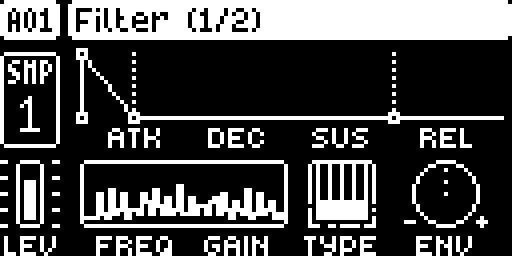
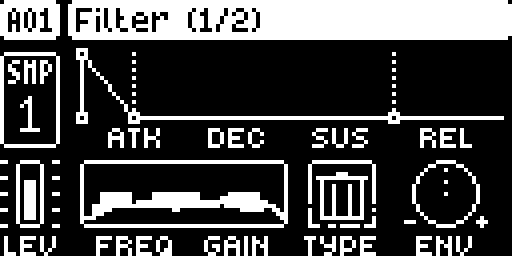
The FLTR page redraws its FREQ/RES response curve for the new types (a
band-pass bell for BP/BP2, comb teeth for COMB, a trash can for TRASH) and shows
a small fixed version of each shape in the TYPE box to the right of the graph:
| COMB |
TRASH |
 |
 |
Digitakt mk1 only. Digitakt II's filter machines are out of scope.
Status
The audio path is done and validated (BP / BP2 / COMB / TRASH), including
the filter envelope, the second FLTR page's comb controls (delay,
harmonics, damping, feedback trim), and the FLTR page's FREQ/RES response
curve and TYPE-box glyphs, which now redraw for the new modes (a band-pass
bell for BP/BP2, comb teeth for COMB, a trash can for TRASH). The DSP is
budgeted at or below the stock filter's cost per voice per block. See
RE_NOTES.md.
Everything in this repo builds (BUILT), lints against core and combines with
digihealth (OK: the mods combine).
Known issues
- BP (TYPE 8) can clip at some frequencies. The band-pass SVF has no output
saturation (the comb does), so with high RESO near the pass-band the output
can exceed full scale. Back off RESO/ENV depth or use BP2. (Tracked for a
soft-clip in the SVF.)
Controls
- FREQ (E) sets the cutoff / comb pitch; RESO (F) the resonance /
comb feedback; the filter envelope (H + ADSR) modulates the cutoff exactly
as the stock types do.
- Second FLTR page, while TYPE is COMB or TRASH, reuses the stock knobs:
Base (A) = delay offset, Width (B) = harmonics (delay divider 1–4),
Env Delay (C) = damping, SRR (D) = feedback trim. Their stock
defaults (Base 0, Width max, Env Delay 0, SRR 0) leave the comb unchanged.
How it works
Three patch sites plus an ev_draw subscription (addresses and the full
reverse-engineering are in RE_NOTES.md):
- widen the Filter Type range field from max 7 to max 11;
- re-point the TYPE label formatter so 8–11 print
BP / BP2 / COMB / TRASH;
- hook the per-voice filter call in the render and run our own DSP for TYPE
8–11, tail-calling the stock filter for everything else;
- subscribe to core's
ev_draw (digifilter_draw, order 40): after the page
has drawn, when the shown page kind is FLTR (6) and the active track's TYPE
is 8–11, mask the stock graph and TYPE box and paint the BP/BP2/COMB/TRASH
response curve plus the mode's small TYPE-box glyph.
(This composes with the event chain; patching the page drawView vtable entry
0x401842a0 directly lost the curve in multi-mod builds.)
Our DSP is integer-only (no FPU, no libgcc): a trapezoidal state-variable
filter for BP/BP2 and two feedback combs for COMB/TRASH. The cutoff and
resonance are smoothed (a coefficient ramp across the block, and a fractional,
smoothed comb delay) so modulating the filter does not step or click. The
filter envelope is added to the cutoff exactly as the stock filter does.
Per voice per render block (measured in digiemu), TYPE 1 (stock) costs ~2400
instructions; BP/BP2 ~2800; COMB/TRASH ~1750 — so the new modes are no more
expensive than the stock filter. The SVF computes its coefficients at the
block's two ends and ramps between them, and the comb's interpolation and
feedback each use a single 32×32 multiply.
Building
Needs the m68k cross toolchain, an elekloader checkout, the stock
Digitakt_OS1.53.syx, and core (2.1). Set up the shell, then build:
export PATH="<m68k-elf bin>:$PATH"          # e.g. C:\SysGCC\m68k-elf\bin on Windows
export ELEKLOADER_CROSS=m68k-elf-
export PYTHONPATH="<elekloader checkout>"

python -m elekloader.sdk.build . --stock <Digitakt_OS1.53.syx>
python -m elekloader.lint  out/digifilter-1.0i.elemod --stock <Digitakt_OS1.53.syx> --with <core-2.1.elemod>
python -m elekloader.patch --stock <Digitakt_OS1.53.syx> --mod <core-2.1.elemod> --mod out/digifilter-1.0i.elemod --out custom.syx --version 2.0t --check
That must print BUILT, then OK: links as core 2.1 …, then OK: the mods combine. Drop --check on the last command to write custom.syx.
core is elekloader's mods/core (built, or its release). Add
--with <digihealth.elemod> / --mod <digihealth.elemod> if you use it — the
third site is chosen so this mod does not overlap digihealth 1.0.
Files
| file |
contents |
mod.json |
the mod: id, version, sites, sources, requires core |
filter.c |
modes, coefficients, the comb DSP, the site entry point |
filter_dsp.s |
the per-voice state-variable filter (ColdFire EMAC) |
filter_glue.s |
the raw site entry points (labels + the per-voice dispatcher) |
filter_ui.c |
the FLTR page response-curve ev_draw handler (digifilter_draw) |
filter_tables.h |
g, k, frequency and comb-delay tables |
tests/filter_model.py |
floating-point reference (svf_block, comb_gain) |
tests/digiemu_filter_*.py |
headless digiemu traces/tests (need a digiemu checkout) |
tools/disas.py |
disassembly helper (m68k-elf-objdump -m m68k:cfv4e) |
tools/re_locate.py, tools/emu_filter.py |
early image/unicorn helpers |
RE_NOTES.md |
the reverse-engineering findings |
Testing
# floating-point model self-test (no toolchain needed)
python tests/filter_model.py

# live tests in digiemu (need a digiemu source checkout + a set-up firmware)
python tests/digiemu_filter_dsp.py  --digiemu <checkout> --fw <folder> --type 8
python tests/digiemu_filter_mod.py  --digiemu <checkout> --fw <folder> --type 10
python tests/digiemu_filter_cutoff.py --digiemu <checkout> --fw <folder>
python tests/digiemu_filter_curve.py --digiemu <checkout> --fw <folder>
Licence
GPL-2.0-or-later. No Elektron firmware is included or committed.