
About
Highlights
- Groove and generators (Euclidean sequencer, Grids)
- Randomisation and pattern clean-up shortcuts
- CAPTURE: an instant sampler in the spirit of Koala Sampler
- TAPE: records the master output to a WAV file on the card
What you need
Nothing to install yet: the repository publishes no firmware, source code or build instructions. It is a place to follow the work.
Good to know
Each feature is labelled by its state: working on the unit, in test builds, or only designed. Tested on an Octatrack MKI only. The author continues the ideas in ot1, a separate custom firmware with its own scripting language.
README
octalab
             █           ▀█         █
▄▀▀▀▄ ▄▀▀▀▄ ▀█▀▀   ▀▀▀▄   █    ▀▀▀▄ █▀▀▀▄
█   █ █      █    ▄▀▀▀█   █   ▄▀▀▀█ █   █
▀▄▄▄▀ ▀▄▄▄▀  ▀▄▄▀ ▀▄▄▄█  ▄█▄  ▀▄▄▄█ █▄▄▄▀
octalab │ ot explorations │ 2026
For four weeks, octalab has explored what can be added to the Octatrack's native firmware, building on octabam and other projects that paved the way for its reverse engineering and custom firmware (octamax, ems-octakit, octa-bt-pt).
Initial additions included Groove, Generators (Euclidean sequencer, Grids), and a suite of randomization tools. The project is driven by a philosophy of collage and unpredictability to assist the creative process. The goal is to provide a starting point you wouldn't have naturally chosen, all in one gesture.
The project then focused on improving and streamlining the sampling workflow on the Octatrack. This first led to Capture, an instant sampler inspired by Koala Sampler, followed by Tape, a meta-recorder inspired by Norns.
Throughout development, a core principle was to avoid overcomplicating an instrument already known for its steep learning curve. The newly implemented shortcuts and pages integrate seamlessly into the Octatrack's legacy OS. Drawing inspiration from devices with state-of-the-art UX, such as Orthogonal Devices' ER-301, these additions naturally paved the way for a full-fledged interface project. This led to ot1: an independent custom firmware built upon octalab's technical and UX discoveries, centered around a brand-new scripting language developed specifically for the OT.

Where octalab stands
| when | |
|---|---|
| early September 2026 | Randomisation: one-gesture functions that fill the sample pool, randomise LFOs, effects, scenes and locks |
| September, 2nd week | GROOVE and the groove pool, Generators (Double trig Euclidean sequencer, MI Grids). |
| September, 3rd week | CAPTURE, an instant sampler on the trig keys |
| end of September | Direct to CF and TAPE: recording straight to the card while the machine plays, a meta-recorder that keeps everything you play, and independent playback beside the eight tracks |
| October | OType scripting language for OT and ot1 cfw. |
A quick note on OT1 and OType
The workflow and screen changes octalab explored are too many to fit as one more module in a remix. They are heading into ot1, an independent custom firmware: fixed rather than remixed, and built around OType, a small scripting language in the spirit of monome Teletype, so that users can add their own functions and shape ot1 to the way they work. A very personal project for now, released once OType is mature: see where it stands on the OType roadmap.
Octalab itself stays an atelier, a workshop. Some features will be made available as modules compatible with Octabam. What can travel as an octabam module will, and octabam modules will run on ot1.
What octalab has studied
Each section says what runs on the unit and what is still in test builds. No firmware, build or source code is published.
Direct to CF: recording to the card, and playing it back
The largest piece of research so far. The stock Octatrack records only into its sample memory: a take is as long as the RAM allows and lives there until you save it. octalab writes audio straight to the CF card while the machine plays, and plays it back on top of the eight tracks.
- Recording, on the MKI: TAPE writes the master to a WAV file in the project folder during a session; CAPTURE saves its pads and chains to the card.
- Playback, in test builds: TAPE recordings play back from the card with cue points on the MKI; loading is still slow and some starts are refused while the card is busy.
- A ninth voice, in the emulator: a playback path mixed into MAIN without borrowing one of the eight tracks runs in the emulator, sample for sample against the stock output; it is next on the unit.
- The hard part is sharing the card and the audio engine: writing while the tracks stream from the card, without a freeze or a dropout. Every build is first played in an emulator against the stock machine, then on the MKI.
CAPTURE
A sampling notepad. The idea here is to bring workflows inspired by MPC, Koala Sampler, OP-1 to Octatrack. Record sounds onto the trig keys, play them at once, and turn the good ones into a kit or a sliced chain without leaving the pattern. CAPTURE borrows the selected track's recorder and records from the external inputs or from a track, from almost any screen.


CAPTURE on the unit: a pad's waveform, CHOP recording, HOLD waiting for the threshold.
Three ways to fill the pads:
- HOLD: arm, then press an empty trig key to record and release it to stop. The pad plays back immediately, Koala-style.
- CHOP: one continuous recording from a playing source. Each press on the next empty pad cuts there: the piece just recorded becomes a pad and recording carries on into the next one.
- DICT: set a threshold and arm a pad. Recording starts when a sound crosses the threshold and stops once it falls quiet again, which suits single hits.
Then trim and shape the pads and SAVE: individual WAVs, plus one sample
chain whose slices are in its .ot file. MAP loads that chain into the
STATIC or FLEX slot of each selected track in one step, so the tracks keep
their machine and settings and get the new material.
State: recording, pad playback and editing, saving, slot assignment, REC arm and the overwrite confirmation run on the MKI. Performance under heavy load (resampling a busy project while writing to the card) is still being worked on.
TAPE
A meta-recorder, like a cassette running in the background. TAPE records what the Octatrack plays (MAIN, or another stereo pair) to a WAV file in the project folder, so a good moment is never lost to not having pressed REC. The target is four channels at once: a stereo pair on tape while CAPTURE records another pair, with no freeze and no dropout.

State: diagnostic test builds have recorded MAIN to the card on the MKI. Reliable long recording while CAPTURE writes too is not reached yet. The TAPE view (record, open a tape, play it back) runs in test builds on the MKI.
GROOVE and the groove pool
After Ableton Live's groove pool. A groove is the timing and dynamics of a real performance, laid onto the trigs you already placed, so that a straight pattern takes a drummer's feel.

On the pattern, it only uses the stock sequencer:
- the timing becomes micro timing, up to almost a step early or late;
- the dynamics become volume p-locks, and a volume lock you set by hand is scaled, not replaced;
- a groove always starts from the trigs as they were, so it can be dialled down or removed later (SLOT back to OFF). New trigs, placed or recorded live, take the groove by themselves.
On the page: SLOT (OFF, or one of the bank's eight), then the track's share of the slot's TIMING and VELOCITY, so that the hats can take half of what the snare takes from the same groove. BAR chooses which bar of a longer groove the pattern starts on. You hear every change as you turn.
The groove pool
Each bank has eight groove slots, like the sample slots. It opens from the bank prompt, with one gesture.

Bank A's pool on the unit: five grooves loaded, the bank's feel pushed to 135 %.
- Change a slot and every track on it follows, in every pattern of the bank: one groove change moves the whole kit.
- A slot's settings follow Live's: TIMING, VELOCITY and QUANTIZE (how much of your played timing is removed first). GLOBAL AMOUNT on encoder A pushes or calms every grooved track of the bank, up to 200 %.
- Grooves are files. A
GROOVESfolder at the root of the card holds them as.otgfiles, a few hundred bytes each. A small converter turns Ableton Live.agrgrooves into.otg, including the ones you extract from your own loops. It keeps up to four bars and recognises straight, swung and triplet feels. No groove data ships with octalab. - Pools and settings are kept with the project in a small file of octalab's own. The Octatrack's project files are not touched, and a project stays readable by a stock OS.
Next: pool presets, every pattern scale (only 1X for now), MIDI files as a groove source.
New workflows and new shortcuts
The Octatrack is famously full: a machine that takes time to learn and asks you to know its manual by heart. octalab studied how shortcuts and a clearer UX can make it more pleasant to use without breaking it: gestures that stay natural for long-time users, placed where the stock machine had none, and nothing that changes what an existing key already does.
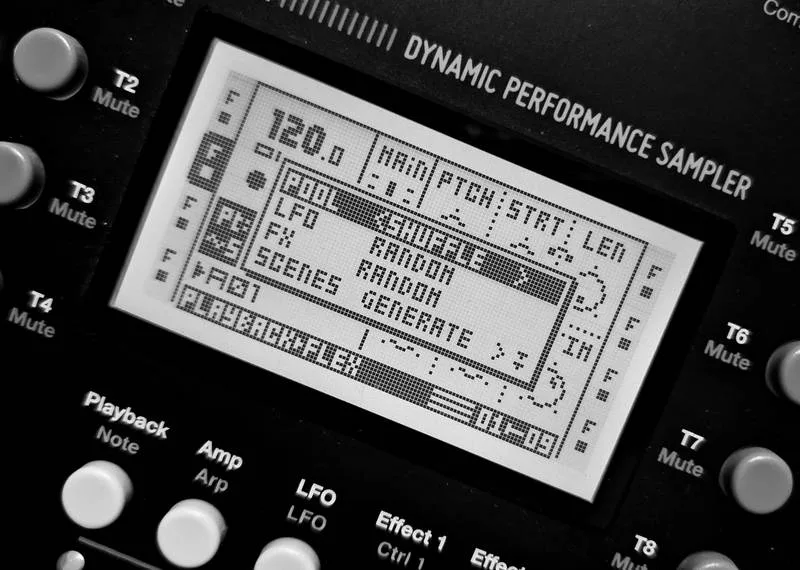
- A function menu: one gesture opens a popup of one-gesture functions, grouped by subject: POOL (fill the free sample slots from the card, shuffle, clear), LFO and FX (random), SCENES (generate, clear), TRIGS (random parameter and sample locks, clear them), TRACK (init). Anything that erases asks YES/NO first.
- From a trig to its sound: in grid recording, a held trig opens the audio editor on its sample lock, or on the sample the track plays.
- Every new page one gesture away: CAPTURE, the groove pool and the grid pages open from wherever you are, and close without a question.

Generators
A euclidean generator page, an exploration of Mutable Instruments' Grids, non-destructive pattern modifiers, and a set of views around the main screen. All these generators will now use Otype.

Additional notes
- Machines: built and tested on an Octatrack MKI running OS 1.40C. The MKII runs the same OS image but is untested.
- Shared with octabam. octalab runs as a module of octabam's remixer and has run on a MKI through octabam's loader daily since 11 Sep 2026. Its findings are written for octabam and the other community projects.
- No build is distributed, now or later: an image contains Elektron's OS.
For other firmware projects
- Findings: addresses, data layouts and the traps that cost a failed
build, each with its confidence level and source image, are in
docs/FINDINGS.md. A coverage response points to the ones that answer gaps raised in another firmware review. - Shared project settings: the OTX proposal and its module guidelines describe one per-project settings store shared by alternative firmwares. Unknown records survive a save unchanged. Not implemented yet.
© 2026 nordseele. This repository's text and images are licensed under CC BY-NC-SA 4.0: credit octalab, non-commercial use, share adaptations alike. Versions published before 27 September 2026 were MIT.
Independent, unofficial, educational. Not endorsed by, supported by, or affiliated with Elektron. "Elektron" and "Octatrack" are trademarks of Elektron Music Machines MAV AB, used here only to identify the hardware under study. "Ableton" and "Live" are trademarks of Ableton AG. "Grids" is a module by Mutable Instruments.
Pictures in the README load from GitHub.
- Language
- HTML
- License
- Other
- Stars
- 11
- Forks
- 2
- Created
- 09-07-2026
- Last commit
- 2 days ago